Morenthya: A Handwritten Font That Feels Like Home
If you’ve ever held a hand-lettered greeting card, admired the delicate swirl of ink on a boutique candle label, or paused to read the warmth in a wedding welcome sign—you know how much emotional weight a handwritten font carries. Morenthya isn’t just another script font—it’s a thoughtful, expressive handwritten typeface designed by Area Type, built for makers who care about authenticity, clarity, and quiet elegance.
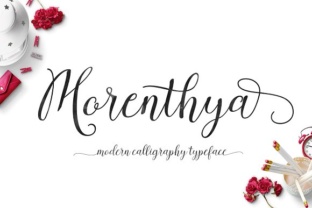
What makes Morenthya stand out in the Script Amp category is its gentle rhythm and intentional imperfection. It’s not overly ornate, nor does it sacrifice legibility for flair. The strokes have subtle variation—slightly uneven baselines, soft entry and exit tails, and natural-looking connections—that mimic real pen-on-paper movement. It feels personal without feeling fragile, decorative without being distracting. That balance is gold when you’re designing something meant to be held, gifted, or displayed.
I use Morenthya across nearly every physical product I make: from small 0.75-inch sticker labels for handmade soaps to full-page printable wall art for nurseries. Its readability holds up beautifully at both tiny and oversized scales. On a Cricut or Silhouette, the clean vector outlines cut crisply—even at 8pt on a tea towel tag—and the letterforms stay distinct without overcrowding. For printed cards or invitations, the spacing feels generous and inviting, never cramped or fussy. And because it’s a true handwritten font, customers consistently tell me my designs “feel handmade,” even when they’re digitally produced.
Think about where that matters most: your candle jar label needs to whisper luxury while clearly stating the scent name. Your wedding welcome board must greet guests warmly but remain easy to read from six feet away. Your holiday mug design should charm without competing with the ceramic texture. Morenthya delivers each time—especially for short phrases, names, titles, and decorative headings. It’s not built for long paragraphs (no script font truly is), but it shines where attention is earned: product names, taglines, monograms, seasonal greetings (“Gather ‘Round,” “Made With Love,” “Welcome Home”), and signature lines on thank-you cards.
Real-world uses I rely on weekly:
- Candle & soap labels: Paired with a light sans serif like Montserrat Light for ingredient lists—Morenthya handles the brand name and scent title with quiet confidence.
- Wedding stationery: Used for couple names on save-the-dates and place cards; its warmth adds intimacy without looking dated or overly formal.
- Farmhouse-style signs: Printed on wood or mounted on canvas, Morenthya gives “Good Morning” or “Bake Sale Today” that lived-in, welcoming feel.
- Digital printables: Planner headers, habit trackers, and printable quote art all gain personality and cohesion with consistent use of Morenthya for titles and accents.
- Tote bags & apparel: Works especially well for single-line phrases (“Brew & Bloom,” “Read Slowly”) where subtlety reads as sophistication—not clutter.
For pairing, I almost always reach for a clean, neutral sans serif—think Inter, Poppins, or Lato—as a grounding contrast. That combination lets Morenthya breathe while keeping layouts balanced and professional. If you're aiming for vintage charm, try it with a delicate serif like Playfair Display for body text—but keep Morenthya reserved for display roles only. Overusing script fonts in mixed typography can muddy hierarchy, and Morenthya’s strength is in its intentionality, not its versatility.
Technically, Morenthya comes with standard OpenType features you’ll appreciate: stylistic alternates for letters like *a*, *g*, and *y*; optional swashes for opening and closing flourishes (great for invitation headlines); and basic ligatures that improve flow in common two-letter combinations (*th*, *st*, *ct*). It supports Latin-based languages and includes uppercase, lowercase, numerals, and punctuation—all in .OTF and .TTF formats. No web font files, but that’s fine: this is a fonts asset built for crafters, not websites.
A quick note on licensing—because it matters: Morenthya is a commercial font, meaning you’re fully covered to use it in physical products you sell (stickers, mugs, packaging), digital downloads (printables, Canva templates), SVG files for cutting machines, and client work (like custom wedding suites). Just double-check the license terms from Area Type before bundling it into editable template kits—but for standard shop use? You’re good to go.
What I love most about using Morenthya isn’t just how it looks—it’s how it shifts the tone of my entire shop. Customers notice the difference between “designed” and “made.” When your lavender-scented candle says “Serenity” in Morenthya instead of a generic script, it doesn’t just name a mood—it invites one. When your printable “First Day of School” sign uses Morenthya for the child’s name, it feels less like a download and more like a keepsake. That emotional resonance? That’s what turns browsers into buyers and one-time buyers into repeat fans.
It’s also a font that grows with your business. Start with simple tags and stickers, then expand into full invitation suites or seasonal collections—all while keeping your brand identity cohesive. Because Morenthya isn’t trend-chasing. It’s steady. It’s sincere. And it’s built to last longer than the next algorithm update or design fad.
If you’ve been searching for a premium font that bridges handmade charm and commercial practicality—if you want your typography to support your story instead of shouting over it—Morenthya is worth every pixel. Not as decoration. As intention.